

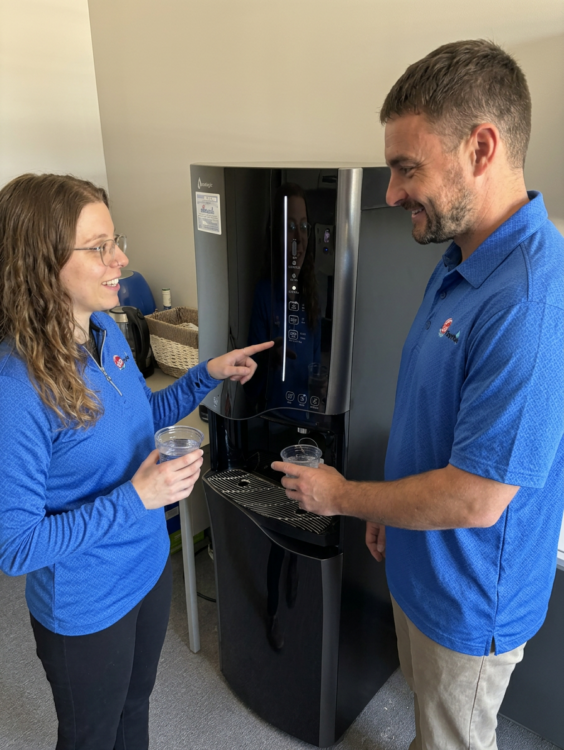
By Casey Irvin and Samina Ajro, PureFlow Water Specialists at Doing Better Business
Your workplace water might taste fine. Your dispenser might work perfectly. But someone still has to order the water, carry bottles inside, find space for extras, and replace the empty jug.
Those tasks can become so routine that nobody stops to consider what they cost.
As PureFlow Water Specialists, we talk with businesses about how they provide drinking water for employees and visitors. Often, the conversation begins with, “We’re happy with what we have.”
When we ask about deliveries, shopping trips, storage, and lifting jugs, we often hear what people would like to make easier.
Bottleless water systems offer another way to supply workplace drinking water. Here are the questions we recommend asking before your next water purchase.
How Much Work Goes Into Keeping Your Water Stocked?
Changing heavy jugs is one of the most common complaints we hear.
Someone has to notice the empty bottle, retrieve a replacement, and change it. If your business purchases water at a store, someone also handles the shopping, transportation, and unloading.
Individual bottles create their own routine: buying cases, storing them, and restocking the refrigerator.
Ask your team:
- Who purchases or orders our water?
- Who carries it inside and replaces the jugs?
- How often do we restock?
- Where do we keep full bottles and empties?
- What happens when we run out?
A bottleless system connects to your building’s water supply and treats water at your workplace. For the dispenser it replaces, that means no recurring jug purchases, bottle storage, or jug changes.
Are Water Deliveries Creating Extra Work?
Delivery can be convenient—until the water does not arrive when expected.
We hear from businesses frustrated by late deliveries and the need to find replacement water while they wait. Keeping extra jugs can provide a buffer, but those backups take up space.
If deliveries are a recurring concern, consider how often your team has to call the provider, rearrange orders, or make an unexpected shopping trip.
A bottleless system removes dependence on jug deliveries for that dispenser. It supplies water on demand, within the system’s capacity, using your building’s water and power connections.
For a busy workplace, that can mean fewer supply-related tasks and less time spent figuring out where the next bottle is coming from.
Could Bottleless Water Cost Less Than Buying Jugs?
Price is understandably one of the first questions businesses ask us.
Our recommendation is to compare what you actually spend today with a proposal suited to your workplace.
DBB PureFlow systems begin around $85 per month, including installation, ongoing service, and filter changes. That equals $1,020 annually.
For comparison, Walmart Business lists a five-gallon Primo exchange bottle at $7.88, with prices varying by location and purchase channel. At that price, regular exchanges add up as follows.
|
Five-gallon jugs exchanged weekly |
Annual jug exchange cost |
Difference compared with PureFlow at $1,020 annually |
|
2 |
$819.52 |
PureFlow costs $200.48 more |
|
3 |
$1,229.28 |
PureFlow costs $209.28 less |
|
4 |
$1,639.04 |
PureFlow costs $619.04 less |
|
6 |
$2,458.56 |
PureFlow costs $1,438.56 less |
At this exchange price, a business using three or more five-gallon jugs weekly could spend less with PureFlow before considering shopping trips and handling time.
Using fewer jugs? Your current water purchases may cost less. Convenience, service coverage, and available features can still be part of the decision.
Bring us a recent receipt or delivery invoice and your typical usage. We can help you compare the numbers.
This illustration assumes 52 weeks of purchases at an unchanged exchange price and a PureFlow price of $85 per month. It excludes applicable taxes, utility costs, purchasing trips, and jug-dispenser purchase or maintenance costs. PureFlow pricing varies by system and installation requirements; request a proposal. Self-service refills require a separate comparison using the actual refill price.
What About the Time Spent Buying Water?
A receipt shows what the water costs. It does not show the time spent getting it.
If an employee regularly leaves work specifically to purchase water, consider the time spent driving, shopping, loading, and unloading.
For example, a dedicated 30-minute water trip every week adds up to 26 hours annually.
Removing those trips can return time to other responsibilities. That does not automatically reduce payroll, but it can make the workday easier.
If water is purchased during an existing shopping trip, count only the additional time and travel involved.
We also recommend looking at storage. How much room do full jugs, empty bottles, and spare cases occupy? Could that space serve another purpose?
Will Installation Disrupt the Workday?
“How difficult is installation?” is one of the questions we hear most often.
People want to know where the system will go, how it connects, and whether the work will interrupt their day.
The process starts with reviewing your space. Depending on the model and location, installation can involve routing small tubing from the water supply to the unit. Freestanding and countertop options can provide flexibility when selecting a suitable location.
Every workplace is different. Our team reviews the proposed placement, connections, tubing route, and other requirements before explaining the installation plan.
We want you to understand what work is needed and how it will be scheduled before installation begins.
Will Your Team Enjoy the Water?
Taste matters, and our advice is simple: try the water for yourself.
We enjoy introducing businesses to reverse osmosis water, and we have received positive feedback about its taste. Your team should have the opportunity to decide whether they enjoy it, too.
We can explain the proposed system’s treatment process, capacity, and maintenance coverage while you evaluate the water.
Think about how employees will use the system throughout the day. Depending on the model, hot-water dispensing can make preparing tea more convenient.
Tell us which features matter to your workplace. We will help you evaluate an option that fits your team’s needs.
Find Out Whether PureFlow Makes Sense for Your Business
You do not have to be unhappy with your current water to explore a simpler way to provide it.
Start with a recent receipt or delivery invoice, your typical weekly usage, and a description of how your team keeps water stocked.
We will help you compare your current routine and expenses with a PureFlow proposal, including installation and ongoing service.

Let’s talk about your workplace water. Request a water assessment or ask us about a free PureFlow trial.